
Keyword research meets prompt research: A smarter way to prioritize topics
I’ve spent most of my career treating keyword research as the foundation of organic strategy. It tells you what people type into a search box, how often, and with what intent.
Now there’s a second demand signal alongside it: what people ask AI assistants. Those conversations reveal demand that keyword research alone doesn’t always capture.
When your audience opens ChatGPT, Perplexity, or Google’s AI Mode and describes a problem in a full sentence, that query often looks very different from the short phrase they’d type into traditional Google Search.
Instead of treating those as separate research exercises, I started putting keyword demand and prompt demand in the same table. The gap between them often determines what kind of content a topic actually needs.
Two research disciplines, one table
For every topic I’m considering for a new SEO campaign, I pull two numbers.
- Keyword volume is how many times people type a keyword into search. I use Google Ads Keyword Planner and cross-reference the data with a third-party tool, usually Semrush or Ahrefs. I start with a list of target keywords, then use each suggested keyword to uncover related opportunities.
- Prompt volume is how many times people ask AI assistants. I use Profound’s Prompt Volumes tool for this. It pulls from a dataset of real prompts people submit to ChatGPT, Gemini, Claude, and Perplexity, then models how often a topic appears across those conversations. You enter a keyword (or a batch of them), and it returns volume, related phrasing, and how that demand trends over time. That’s the prompt-side number I put next to traditional monthly search volume data.
I use this data to build a simple spreadsheet. The keyword column represents search demand. The prompt column represents AI-answer demand. It’s also important to understand some nuances in the tool outputs. Keyword Planner merges close variants, so near-duplicate phrases report the same figure.
I wouldn’t count them as separate demand. Prompt volume is generally more directional. I find it reliable for comparing orders of magnitude, which is what this method needs, but less reliable if you rely too heavily on specific numbers.
Dig deeper: Prompt research: The next layer of SEO and GEO strategy
See where your brand appears in AI search, where competitors are winning, and what it takes to become the answer AI recommends.
What the gap actually tells you
Once both columns are filled in, topics can fall into a few strategic content buckets, depending on the relationship between keyword and prompt volume.
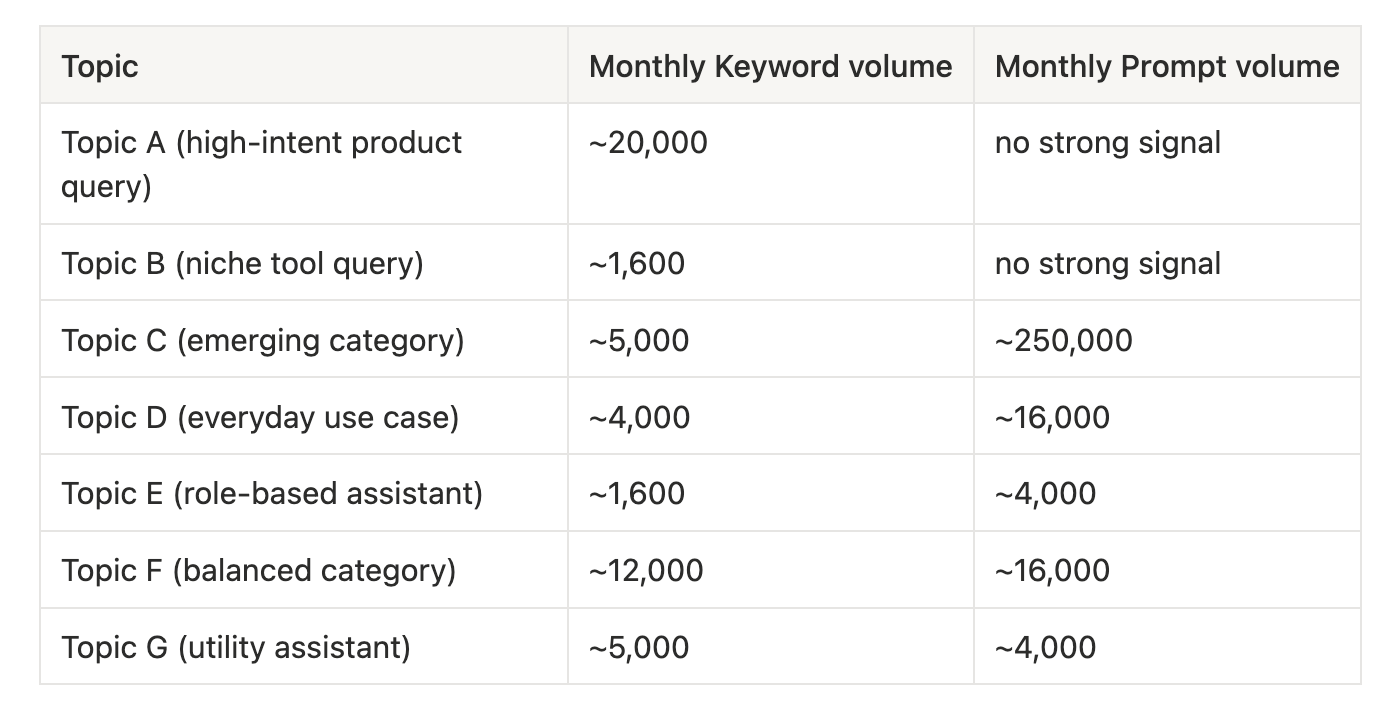
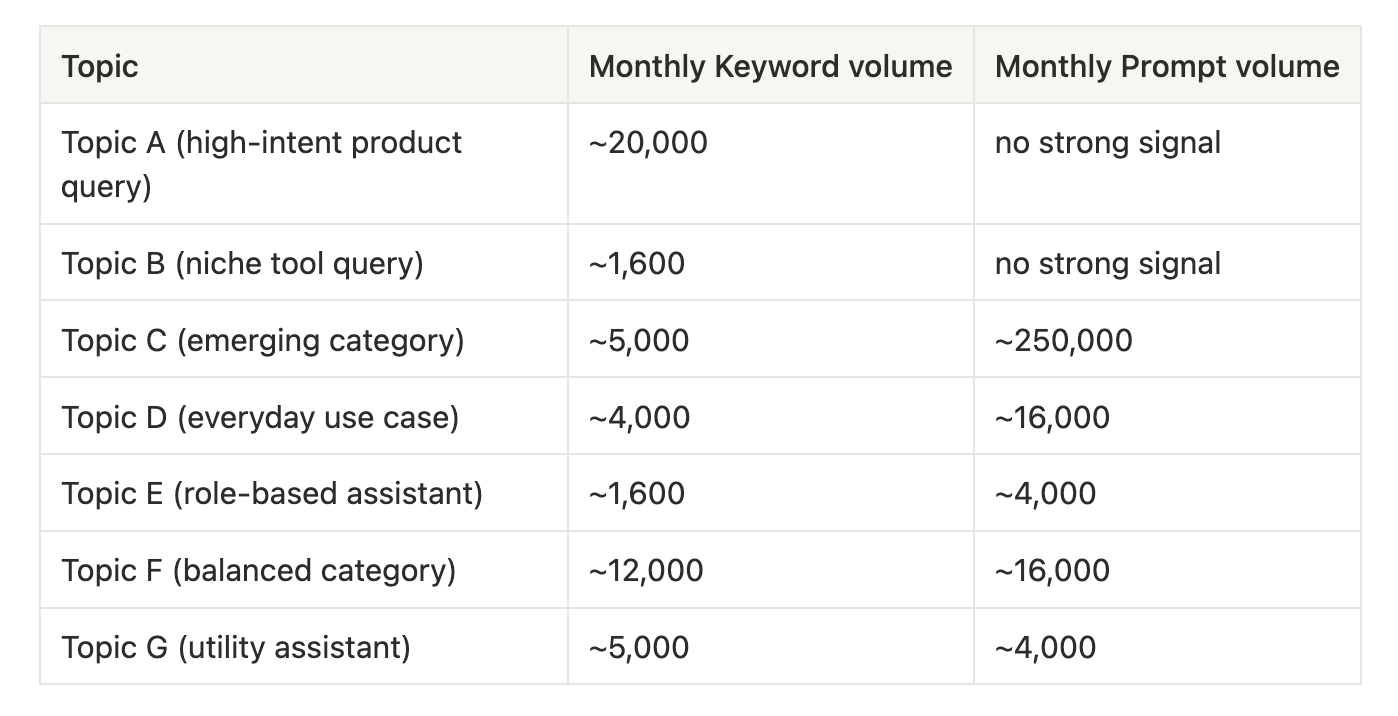
Here’s a real sample from a batch I ran recently. The topics are anonymized, and the numbers are rounded to the values reported by the tools.
Keyword-strong, prompt-weak: Write the classic SEO page
Topic A pulls roughly 20,000 monthly searches and almost no prompt demand. People search for it, but they aren’t asking an assistant to walk them through it.
Topic B follows the same pattern at a smaller scale: decent search demand but a weak prompt signal.
For these, I start with a keyword-led plan and stay honest about where the demand is. People are searching for this in Google, not asking AI about it, at least not yet. So the brief looks like a traditional SEO brief.
I look at what’s already ranking:
- What does the SERP reward for this query?
- What questions are the top pages actually answering, and where are they thin?
Then I ask the only question that matters for the page I’m about to build:
- What can I say here that nobody else is saying, and how do I answer the searcher’s question completely?
From there, I work top-down through the entire document.
- The title and H1 match the keyword and intent.
- The opening answers the question early.
- The rest of the page covers related questions, definitions, and supporting information the SERP rewards.
- HTML is structured in a way that makes the answer easy to parse through clear headings, short definition blocks, and conclusions near the top of each section.
The point for this bucket isn’t to force an AEO rewrite onto a search query. It’s to win the keyword based on how the SERP works today while making the page substantive enough that, if AI search starts citing this topic later, there’s something meaningful to pull from.
Dig deeper: The infinite tail: When search demand moves beyond keywords
Prompt-strong, keyword-weak: Write for the answer, not the SERP
This is the group keyword research alone that you will miss. It’s also the part of the method I rely on most.
Topic C reports about 5,000 monthly searches. Based on keyword volume alone, I’d probably deprioritize it. But it pulls roughly 250,000 in prompt volume. Keyword search volume understates demand for this topic by about 50 times. People aren’t typing exact-match keywords into Google. They’re describing the problem to an assistant and asking what to do about it.
Topic D shows about 4,000 searches against 16,000 prompts. Topic E follows the same pattern at a smaller scale.
For these, I want content built to be the answer itself: clear definitions, direct responses to the questions people actually ask, and a structure an LLM can extract and cite. The goal is to get cited within the answer.
This is where teams leave the most demand on the table. Topics can look “small” in Keyword Planner yet dominate prompt volume, and teams that rely only on keyword research never even put them on the roadmap.
Strong on both: Build the flagship
Topic F reports roughly 12,000 searches and 16,000 prompts. Topic G sits in a similar range on both sides. When a topic shows demand on both surfaces, I fund it like a pillar. These are the pages worth building to rank in search and get cited in AI answers.
This is also where the two research disciplines stop feeling like separate exercises. Keyword research tells me how to structure and title the page for search. Prompt research tells me which questions to answer and how to phrase them so an assistant will pull from the page. Together, they help me build a page that’s designed for both surfaces.
A note on empty cells: When the prompt column comes back empty, don’t read it as zero interest. Often, the demand is there but bundled into a broader head term or different prompt categories. A narrow use case might show nothing on its own while rolling up under a much larger prompt topic.
A blank means “no clean matching term here,” not “nobody cares.” Check the head term before you write off a topic. I’ve definitely missed some good early opportunities by not following this rule.
Turning the table into a strategy
The table is only useful if it changes what you ship. Once topics are sorted, the roadmap is straightforward:
- Keyword-strong topics feed the traditional SEO queue: ranking pages matched to search intent.
- Prompt-strong topics feed the answer-engine queue: referenceable, extractable content designed to be cited.
- Strong-on-both topics become your flagships: invest in them and build for both surfaces at once.
Then measure the two surfaces separately. Split your organic reporting so classic search traffic and AI-referred traffic are distinct, rather than blending everything into one “organic” number.
On my team, we separate organic search from AI search sources like ChatGPT and Perplexity, so we can see whether a piece of content is earning traffic on the surface it was built for.
Building great content helps you perform across SEO and AEO. Looking at both demand signals helps you decide how each topic should be approached. The better your data, the more specific your iterations can become, and the more you’ll learn from every piece you publish.
Dig deeper: How to design content that AI systems prefer and promote
Track your visibility across AI search, uncover missed opportunities, and grow your presence where customers are asking questions.
Why I’m running both now
For years, keyword research was enough because search was the only discovery surface that mattered. That stopped being true once a significant part of the journey began before the click, in a conversation that doesn’t look like a keyword.
Running prompt research alongside keyword research lets me stop guessing where demand actually exists. I can see the actual demand for a topic instead of building the same page for every type of query.
Teams that continue treating these as a single demand signal will keep missing the topics where they diverge.
