
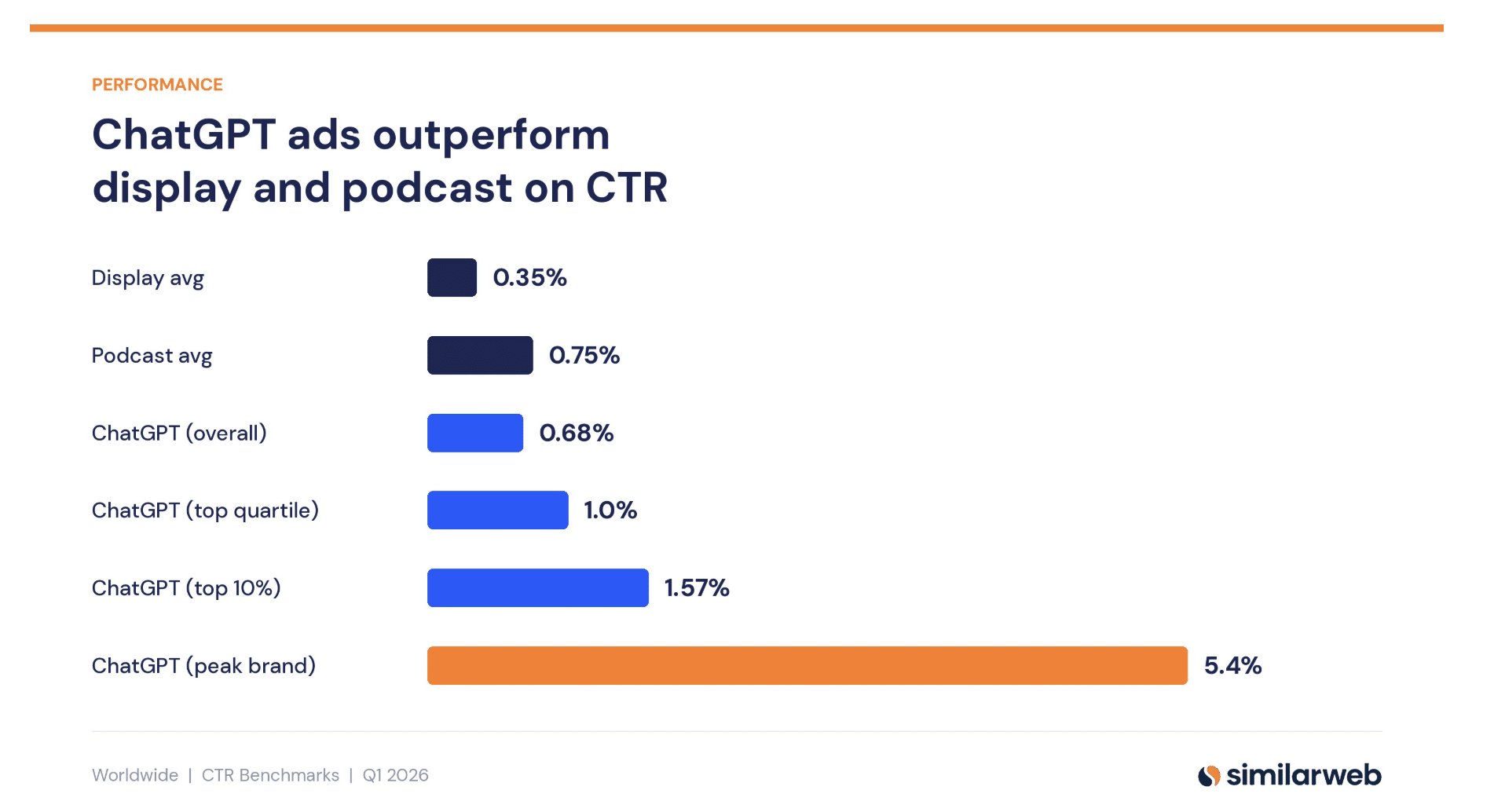
ChatGPT ads show strong early CTRs — but scale is still the question

Initial reports from SimilarWeb indicate ChatGPT ads are outperforming traditional benchmarks on engagement — but with limited inventory and small-scale tests, it’s too early to call this a long-term trend.
What’s happening. According to early analysis, ads appearing in ChatGPT conversations are generating strong click-through rates vs Display and Podcast channels, likely driven by high-intent user queries and the native way ads are integrated into responses.

Unlike traditional search ads, these placements appear directly within conversational answers, making them feel more contextual and less disruptive.
Why we care . If these early CTRs hold at scale, ChatGPT could become a serious performance channel — especially for advertisers looking to reach users at the moment of intent.
But there’s a catch: inventory is still limited, and early performance often looks better before wider rollout introduces more competition and variability.
Between the lines. High CTRs don’t necessarily mean high performance. Conversion quality, cost efficiency and scalability will ultimately determine whether ChatGPT ads can compete with established platforms like Google Ads.
There’s also the novelty factor — users may be more likely to engage simply because the format is new.
Zoom in. Some categories are already showing stronger signals than others.
Mother’s Day-related prompts are far more likely to trigger ads—about three times more than average—because they signal strong purchase intent, with brands like Etsy, Nordstrom and flower retailers already showing strong visibility.
What to watch:
- Whether CTRs hold as inventory expands
- How conversion rates compare to search and social
- If pricing models evolve beyond early testing phases
Bottom line. ChatGPT ads are off to a strong start on engagement — but until scale, cost and conversion data catch up, advertisers should treat this as a promising test channel, not a proven one.
Dig deeper. Advertising in AI: Insights from Real User Behavior
