
Click fraud in Google Ads: Where exposure rises and how to reduce it

Google has long been considered the gold standard for ad spend compared to social platforms. But scale doesn’t equal immunity. Click fraud remains a persistent risk, and the safety of your budget depends entirely on where your ads are running.
While Google Ads offers immense reach, its campaigns aren’t created equal. Some are significantly more exposed to malicious activity than others. To protect your margins, you must understand what constitutes click fraud, where it originates, and how to shield your campaigns.
What are invalid clicks?
Invalid clicks are interactions that lack legitimate consumer intent. Because they aren’t driven by real human interest, they skew performance data and drain budgets without any possibility of conversion. These clicks generally originate from four primary sources:
- Botnets: Networks of hijacked devices controlled by a “botmaster.” They generate massive volumes of automated traffic that mimic human behavior to inflate metrics or carry out DDoS attacks.
- Click farms: Large groups of low-paid workers or automated scripts tasked with manually clicking ads. They create an illusion of high engagement, misleading brands into believing a campaign is more effective than it truly is.
- Ad injection and malware: Malicious software that “injects” unauthorized ads into websites or forcibly redirects users. This hijacks legitimate revenue and erodes consumer trust.
- Pixel stuffing and ad stacking: “Invisible” fraud in which ads are served but never seen. Pixel stuffing compresses an ad into a single 1×1 invisible pixel, while ad stacking layers multiple ads on top of each other in a single slot. You pay for thousands of impressions that have zero chance of being viewed.
Dig deeper: Own your branded search: Building a competitive PPC defense
The rising trend of fraud
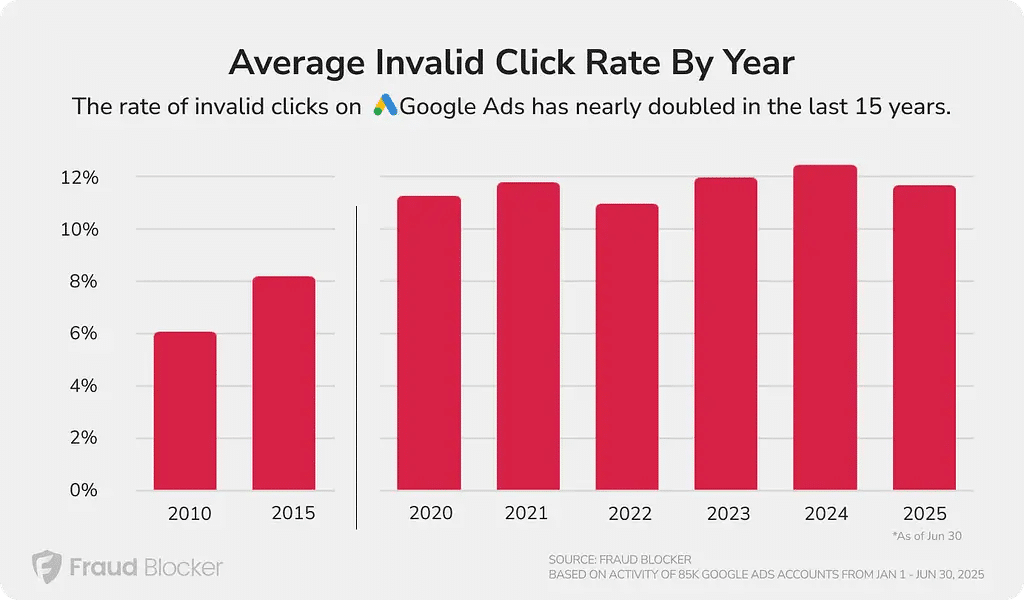
The average invalid click rate across Google Ads is 11.4%, a recent study by Fraud Blocker found. The figure is climbing.
That upward trend becomes clearer over time. In 2010, the average invalid click rate sat at 5.9%. By 2024, that number jumped to 12.3%. This doubling of fraud is likely driven by the increased sophistication of AI-powered bots and malware that can more effectively bypass basic security filters.

Invalid click rates fluctuate based on your campaign setup. Three key factors typically drive these numbers:
- Industry competition: High CPC industries like legal services, insurance, and real estate are primary targets. Competitors or bots may intentionally target these campaigns to exhaust your daily budget.
- Targeting parameters: Overly broad keywords or targeting regions known for high botnet activity can inadvertently invite “junk” traffic.
- Refinement tools: Negative keywords and audience exclusions act as a shield, reducing the frequency of unintentional clicks.
The SEO toolkit you know, plus the AI visibility data you need.

Campaign hierarchy: Which are the biggest violators?
Not all Google Ads inventory carries the same level of risk. Here’s how campaign types stack up from highest to lowest exposure.
The biggest risk: Google Video Partners
- Video Partners show the highest levels of invalid traffic since they reach beyond YouTube to Google’s network of third-party sites.
- Many of these sites offer zero control, racking up views from bots or “muted” placements in tiny windows where real people never see them.
Display campaigns: Highly vulnerable
- Display ads are often plagued by low-quality “made-for-ads” or AI-built sites.
- In some cases, more than half of the clicks on a specific site can be invalid.
- While major publishers are safer, the risk across the wider network is uneven and requires constant monitoring.
Shopping and Demand Gen: The automation tax
- These campaigns face less malicious fraud from price-checking tools, scrapers, and automated bots.
- While not always intended to deplete your budget, these clicks still drain spend and skew optimization data, which is particularly damaging for low-margin businesses.
Performance Max: Hidden exposure
- While PMax scales inventory across all Google properties, it spreads risk across the entire ecosystem.
- Because it’s difficult to see exactly where traffic originates, even a low percentage of invalid clicks can result in significant wasted spend.
Search: The safest bet
- Traditional Search campaigns remain the most secure.
- It’s much harder for bots to accurately mimic a human searching for a specific solution.
- However, in high CPC industries, even a 2% fraud rate can be financially painful.
How to mitigate the risks
Across the diverse range of industries my clients serve, I’ve identified specific patterns in how fraud manifests across different sectors. As a result, the best prescription is proactive. Address these vulnerabilities by shifting from broad, automated settings to a more refined, high-intent strategy.
The following table highlights the specific patterns we monitor to lower invalid click rates:
| Factor | Higher risk (Aggressive) | Lower risk (Strict) |
| Location | Global or “Presence or Interest” | “Presence Only” (User is physically there) |
| Keywords | Broad match / Generic terms | Exact match / Long-tail phrases |
| Networks | Including “Search Partners” and “Display” | Google Search Network only |
| Exclusions | No negative keywords or placement lists | Robust negative lists and app exclusions |
| Scheduling | 24/7 (Bots often spike at night) | Custom schedules aligned with business hours |
Here are proactive steps you can take to reduce your exposure to fraud.
- Audit placement data: Regularly review where your ads appear. Immediately exclude low-quality apps or sites that show high click-through rates but zero conversions.
- Limit AI Max overreliance: Automation is powerful, but set and forget is a recipe for wasted spend. Maintain manual guardrails on your automated campaigns.
- Review refunds: Google does issue refunds for detected fraud, but subtle cases often slip through. Compare your internal lead data against Google’s click data to find discrepancies.
Dig deeper: PPC in the age of zero-click search: How to stay profitable
Campaign structure is your first fraud defense
Google is far from a uniform entity. It’s a diverse ecosystem of distinct environments where risk levels can vary by as much as 400%.
Prioritizing high-quality traffic results in superior data integrity, more precise optimization, and reduced acquisition costs. In today’s market, the strategic structure of your campaigns is just as vital to your success as the size of your budget.
