How to work with your SEO agency to drive better results, faster

Hiring an SEO agency can be a game-changer for brands looking to outshine the competition in search results.
That said, an SEO agency is only as good as its partnership with its clients. That’s when SEO’s true value can be realized.
What this looks like practically is working together towards shared goals and keeping momentum high. Sometimes that’s easier said than done.
Here’s what you can do to ensure you get the most from your SEO agency partnership.
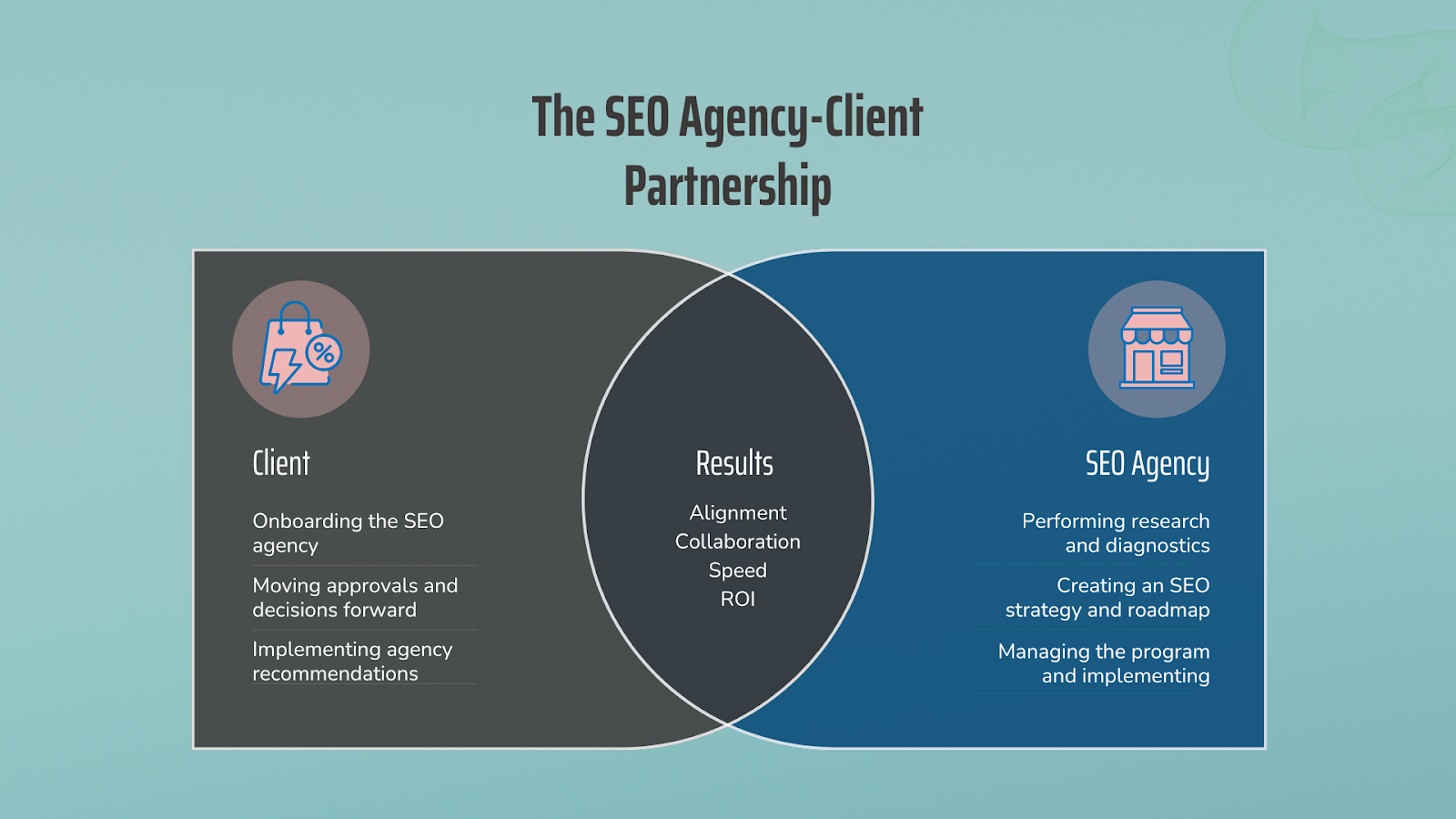
Because when you’re aligned, you make progress faster and, in turn, can better prove ROI.

Align SEO with what moves the business
Your company sets the business goals, and SEO’s job is to get the traffic to help you reach them.
The more you align on goals with your agency, the more effective an SEO program will be.
Before any campaign is launched, the business and the agency need to discuss how to align SEO with your business goals.
This meeting is even more effective when you can get cross-departmental stakeholders to weigh in.
Objectives can be anything – for instance, market expansion, revenue, building brand authority, enhancing the customer experience, or something else. When executed well, SEO can support nearly any business goal.
This is also an excellent time to facilitate SEO training across teams.
When departments are aligned on the foundational concepts of SEO, they can understand SEO’s function and their role in it.
Dig deeper: SEO prioritization: How to focus on what moves the needle
Set the agenda for a productive kickoff
What does a productive kickoff meeting look like? Here are some things that are important to cover:
- Your pain points: Even if you already discussed your SEO pain points during the sales call, it’s important that your SEO team hears it directly from you and has an opportunity to ask questions.
- The ins and outs of your business: Help the SEO team understand your business as best you can. You know your industry better than anyone, and the more the agency knows, the better your SEO program will be.
- The program’s scope: Make sure you understand the scope and everyone’s role in the project. For example, how long is each phase of the project? Who is responsible on the agency side for which tasks? Who will move things forward at the client company?
- In-house capabilities: Update your SEO team on your current capabilities and resources, such as how many writers, developers or designers you have available for tackling tasks.
- Common roadblocks: Discuss how to prepare for common roadblocks in SEO implementation. Your SEO agency is well-positioned to speak about these kinds of things, so you can be proactive on your end.
- Communication methods: You will want to know how to communicate with the agency (emails, Slack channels, Zoom meetings, etc.) and how often. The more communication, the better. Both parties benefit from staying top of mind; the last thing you want is to sign a contract and then things go dark.
- Reporting methods: Find out how the agency will report progress. Is it monthly? Quarterly? In what formats will the reports be delivered? Will the reporting structure meet your needs to show ROI to stakeholders?
Setting all these expectations early creates accountability that keeps the project moving and makes it easier to measure success later.
The SEO toolkit you know, plus the AI visibility data you need.

If needed: Shift your mindset from ‘SEO vendor’ to expert partner
If you’ve put in the research, vetted several agencies, and hired the best one, then there’s a bit of mindset work that may need to happen next to make the relationship as strong as it can be.
While blind trust isn’t the goal, SEO agency clients should prepare themselves to receive and trust their SEO agency’s advice – after all, that’s why you hired them.
Give your agency the visibility it needs to perform
This is relatively simple.
Giving your SEO agency full visibility into historical and real-time performance sets your SEO team up for success on day one.
Set up a protocol for agency access to:
- Google Search Console, GA4, Bing Webmaster Tools, your CMS, and relevant third-party analytics or reporting tools.
- CRM data or lead-quality feedback to help the agency align SEO efforts with revenue goals.
- Any context on past search performance, campaign history, and prior SEO initiatives.
- Revenue or operational data as needed, so you have another way to corroborate SEO performance.
Finally, ensure agency access is built into onboarding for any new tools and systems you adopt that may impact SEO.
Dig deeper: How to onboard an SEO agency the right way
Make SEO a cross-functional effort
SEO often needs the cooperation of many teams.
If you’ve done a good job of including the department leaders in the SEO planning phase, then you will likely get more done.

To remain accountable, it’s advisable that all necessary team members attend key meetings with your SEO agency.
The more they hear things firsthand, the smoother the implementation will go.
However, even the best plans can go awry when teams with competing priorities collide. This might be a question of culture, but that doesn’t mean you can’t make progress.
You might look into solutions like:
- Cross-departmental team-building activities.
- Open communication about the purpose and goals of the SEO project.
- Feedback loops to review the status of your interdepartmental collaboration and identify ways to improve.
The more streamlined and responsive the collaboration, the faster your SEO efforts can gain traction.
Create SEO content that’s powered by brand knowledge
Your agency brings deep expertise in SEO, but only you know your brand, offerings, and customers on a deep level.
This is why collaboration on content is necessary to create truly relevant, helpful content that search engines will rank.
Rather than relegating SEO content to the agency with minimal involvement, commit to being an active partner in the process.
This can include the following action items:
Align on voice, brand, and messaging early
Sharing brand guidelines, tone of voice, and existing messaging frameworks are all helpful.
Your agency should work as an extension of your marketing team, and that starts with having some guidelines for how the brand communicates.
Transfer institutional knowledge
Nothing can get a content team up to speed quicker than reviewing existing content assets or plugging into an internal calendar.
Here are some ways to transfer knowledge with your SEO agency:
- Provide access to internal resources like product documentation, customer FAQs, or sales enablement content.
- Keep the team updated on relevant marketing and sales activities, such as events and promotions.
- Give real-time access to an editorial calendar to help plan for future content for the site, whether it’s editing existing pages or creating new ones.
Bring subject matter experts into the process
Identify in-house subject matter experts who can provide input or be interviewed as needed for the content.
You can’t satisfy the “experience” or “expertise” aspect of Google’s E-E-A-T framework for quality content without some firsthand knowledge.
Collaborate before content is written
Work together on outlines or briefs to align on structure and intent before drafting begins.
Content is much stronger when in-house and agency teams are aligned before the content creation process starts.
Review for relevance
Review drafts not just for accuracy, but for alignment with your customers’ needs and expectations.
The most important thing in SEO content is ensuring it’s relevant to your customers.
The best content will align with your brand and your customers and sound like it came from your company.
Strong SEO content comes from brands that bring the knowledge only they can provide.
Remove the approval friction that slows SEO down
One of the biggest bottlenecks to SEO progress is waiting. Waiting for approvals, feedback, access, answers – all of these hinder your ability to compete faster in the search results.
For a more streamlined process, approve all deliverables and tasks promptly.
Making a commitment to moving the project forward could mean you have hard deadlines for turnaround times.
To make this step more efficient, you can look into:
- Analyzing the approval workflow and identifying any bottlenecks upfront.
- Eliminating unnecessary approval steps or people to simplify the process.
- Establishing clear review/approval guidelines upfront to reduce confusion, which can slow the approval process.
- Using technology that helps make the process smoother (like Slack or others), where people can collaborate with ease.
- Leaning on your SEO agency to prioritize which tasks will yield the highest return and go from there.
In SEO, speed is often a competitive advantage. Streamlining the approval process is one way to keep momentum.

Prioritize implementation above all else
Don’t be surprised by the results you didn’t get from the work you didn’t do.
Often, there are SEO tasks that need to be implemented on your end and require resources.
Not implementing SEO agency recommendations is a prevalent challenge, and probably one of the biggest reasons clients end up leaving an agency.
The sole purpose of spending anything on marketing is to bring more money in than went out.
When internal teams stall on implementing SEO tasks, it can halt the agency’s momentum, hinder your search progress, and waste the company’s budget.
Technical SEO execution is often where SEO projects lose the most momentum.
This is where bringing in IT and dev teams early on in the SEO process is invaluable. When they understand why a change matters and impacts performance, they are more likely to get on board.
Regardless, you can still build in some guardrails to be proactive:
- Prioritize SEO tickets in sprint planning.
- Involve IT or dev early in discussions that include technical implementation.
- Allow direct communication between your agency and development team to speed up resolution.
- Create a process for flagging and tracking outstanding technical tasks.
Take the time to make the updates that your SEO team says are worth the effort.
If the task is difficult or time-consuming but will have a big impact, do everything you can to get it done.
Doing what your competitors are unwilling or unable to do is how you win.
The technical foundation is what enables SEO to scale. The faster you can clear any roadblocks here, the sooner your investment starts delivering results.
Dig deeper: Why governance maturity is a competitive advantage for SEO
Track, optimize, and win in Google and AI search from one platform.
Stay engaged long after the kickoff
SEO is a long game. It’s only natural that excitement and momentum are high early on, but after a while, engagement can taper off.
Client-agency partnerships often find their groove over time. The brand trusts the agency, and the agency knows what to do.
But from this place, cracks can begin to form. Maybe you’re not communicating as much, and that lack of communication can lead to gaps in knowledge – on both sides.
Here are some tips to help you stay just as engaged on Day 365 as you were on Day 1.
Be present in reviews and check-ins
Be sure to attend regular check-ins and reporting calls to review progress and surface questions.
It’s easy to miss calls when things pull you away, but staying committed to SEO means showing up, even if it’s just for 15 minutes.
Keep SEO connected to business changes
Share updates on business priorities, product launches, or changes in market strategy.
It’s important that SEO remains at the strategy table so it can adjust as needed.
Use performance data to drive conversations and decisions
Trust in your SEO agency also comes with accountability. So hold your SEO team accountable.
If you see a decline in rankings, traffic, or revenue coming from search, you need to have a conversation if they haven’t already brought it up.
Use these performance insights to adjust tactics, reallocate resources, or explore new opportunities.
Strong SEO results start with strong partnerships
SEO works best when both sides do their part.
The more aligned and collaborative you are with your SEO agency, the faster your SEO program can gain traction and deliver value.
When both sides bring their expertise, stay engaged, and remove friction from the process, SEO becomes a strategic business initiative.
